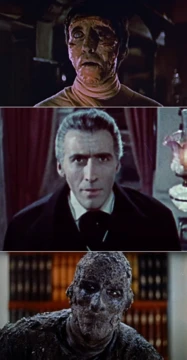
Horror films of Britain
British horror cinema rooted in gothic literature and silent film.

Wikipedia / Wikimedia Commons
British horror cinema is a distinct subset of the genre, produced by studios in the United Kingdom. Its roots stretch back to the silent films of the early 1900s. The most commercially successful period for these films spanned the 1950s to the 1970s, driven largely by Hammer Film Productions. From the genre's beginnings in the 1910s through the end of Hammer's major output in the 1970s, a defining trait was the reliance on storylines drawn from or inspired by 19th-century Gothic literature.
The silent era of British horror was heavily shaped by that same Gothic literary tradition, particularly influential works like Mary Shelley's *Frankenstein* (1818) and Bram Stoker's *Dracula* (1897). This cinematic wave emerged during World War I, and the war's widespread violence, injury, and death left a deep mark on films made in the following years and decades. Spiritualism became a recurring theme, largely because the British public was mourning the dead. Silent horror films often depicted efforts to maintain a spiritual link with the deceased, with filmmakers using Christian imagery and anxieties about the afterlife to create dramatic tension.
Short silent films grew in popularity alongside this Gothic horror trend. An early example is Will Barker's 1919 film *The Beetle*, based on Richard Marsh's 1897 novel, which told the story of an Egyptian princess whose soul transforms into a monster capable of possessing ordinary people. As the British horror genre expanded, it began to influence American cinema. In 1916, British director George Loane Tucker produced *The Man Without a Soul*, a film inspired by Mary Shelley's *Frankenstein* that depicted a protagonist trying to create life by reanimating a soulless man, though this was a British production filmed in the United Kingdom.
During the 1930s and 1940s, horror was firmly established as a genre in American cinema, particularly through Universal's films. Scholar Ian Conrich noted that British horror from this era is often overlooked in historical accounts, usually not acknowledged until Hammer Films emerged in the late 1950s. Conrich argued that no true horror films were made in Britain during this period; instead, there were films with a "horrific" nature that were primarily comedies, thrillers, or melodramas. T
- origins
- 1910s silent era
- key_studio
- Hammer Film Productions
- peak_period
- 1950s to 1970s
- defining_influence
- 19th-century gothic literature
- notable_early_film
- The Beetle (1919)
- notable_21st_century_film
- 28 Days Later (2002)
Lore & Background
British silent horror drew its influence from gothic literature of the nineteenth century, including Mary Shelley's Frankenstein (1818) and Bram Stoker's Dracula (1897). The rise of British silent horror cinema coincided with World War I, and the war's violence and death had a profound impact on films. Spiritualism became a prominent thematic focus, reflecting the British public's mourning, with filmmakers using religious uncertainties and perceptions of the afterlife for dramatic effect. Early examples include The Beetle (1919).
Reader's Guide
From the 1950s to the 1970s, Hammer Films dominated the horror market with adaptations of Gothic novels such as The Curse of Frankenstein (1958). David Pirie declared that Hammer's style was unique to Britain, calling it 'the only staple cinematic myth which Britain can properly claim as its own.' The 1980s and 1990s saw few British horror films, with most being critical and commercial failures. The 2000s marked a dramatic change, with hits like 28 Days Later (2002) and Dog Soldiers (2002) launching a sustained period of British horror production. Hammer resumed making films in 2007 under new ownership, though its name was less central to British horror film culture than in previous decades.
Did You Know?
- The first British production to receive the BBFC's 'H' rating was The Ghoul (1933), not The Mummy (1932); the 'H' rating was introduced in 1933.
- British director George Loane Tucker's The Man Without a Soul (1916) was a British production filmed in the United Kingdom.
More in British horror films 1-24
Spotted an error? Know more?
This is a living reference — every entry is fact-audited, and reader corrections feed straight into our audit queue. Suggest an edit · See this site's audit record