Frequently Asked Questions
The most-asked questions about british horror films.
What distinguishes British horror from American or other national horror traditions?
British horror tends to favor atmosphere, literary source material, and social or psychological unease over the high-octane violence and formulaic structures more common in American slasher or found-footage films. It often treats horror as a vehicle for exploring class, religion, or national identity rather than purely as spectacle.
Who are the most important figures in British horror history?
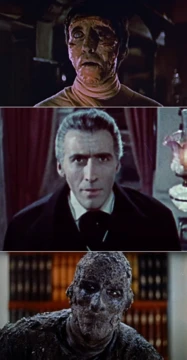
Actors Christopher Lee and Peter Cushing became global icons through the Hammer Films era, while directors Robin Hardy, Danny Boyle, and Neil Marshall shaped distinct later waves of the genre. Author Clive Barker also left a major imprint through the Hellraiser franchise and his broader body of dark fiction.
What exactly was Hammer Horror?
Hammer Horror refers to the string of gothic monster films produced by the London-based Hammer Film Productions between roughly 1958 and 1972, shot in vivid Technicolor at their Elstree Studios. Titles like Dracula, The Curse of Frankenstein, and The Mummy became cult classics and defined a particular brand of stylish, adult-oriented supernatural horror.
Where should a first-time viewer of British horror begin?
The Hammer Dracula and Frankenstein series offer the most accessible and visually striking entry point for newcomers. For a deeper cut, The Wicker Man (1973) is the essential folk-horror text, and 28 Days Later (2002) represents a peak of modern British horror.
What is folk horror and why is it so closely tied to Britain?
Folk horror is a subgenre in which rural communities are bound by ancient, often pagan rituals that pose a threat to outsiders, drawing heavily on British mythology, local legend, and the landscape of the countryside. The Wicker Man (1973) is the genre's defining British film, and a wave of new folk-horror productions in the 2010s and 2020s has kept the tradition alive.
What are some of the most iconic or shocking moments in British horror?
The Wicker Man's closing sequence, in which the protagonist is burned inside a giant straw figure, is frequently ranked among the most jarring endings in cinema. The silent, empty-London opening of 28 Days Later, and the cave-dwelling reveal in The Descent (2005), are other set pieces fans regularly cite as defining moments.
How has British horror changed from the 1950s to today?
The genre has cycled through the theatrical gothic of the Hammer era, the psychological and folk-horror wave of the late 1960s and 70s, the body-horror and sci-fi hybrids of the 1980s, and the fast, visceral style of the 2000s and beyond. Despite these shifts, a preference for literary storytelling and social subtext has remained a through-line.
What early-1960s British horror films are often overlooked?
Michael Powell's Peeping Tom (1960) and Jack Clayton's The Innocents (1961) are frequently cited as masterpieces of psychological horror that sit alongside the more widely known Hammer output. Both films use restrained, almost theatrical staging to create dread and influenced later directors working in the genre.
What recurring themes define British horror as a whole?
Common threads include the threat of the past—history, religion, class—pressing into the present, the corruption of rural or institutional spaces, and a deep suspicion of authority and conformity. Many British horror films also treat the body as a site of social or political anxiety rather than merely a source of gore.
Is British horror still being made today?
Yes, the tradition continues with new feature films and television series that blend horror with thriller, sci-fi, and social drama. The folk-horror revival of the 2010s and 2020s, along with ongoing work by directors in the psychological and body-horror spaces, shows the national tradition is still actively evolving.